Logo
HomeAboutBlogStudio
Back to Compendium

Category

Development

Browse through everything published in Development. Keep scrolling to discover more content.

  • A sleek, dark-themed banner image featuring the Tailwind CSS logo on the left, connected by a network of glowing lines to the React logo (a white atom-like symbol) in the center, and the Next.js logo (a dark blue hexagon) on the right. The top text reads 'TAILWIND CSS: The Future of Web Development with React & Next.js.' Below the logos, it says 'AI-Powered UI: Utility-First Components.' The background is a futuristic grid with a blue glow on the left and an orange glow on the right, symbolizing modern technology.
    Oct 30, 2025Development

    💻 Why Tailwind CSS is the New Standard for Modern Web Development

    Tailwind CSS has revolutionized modern web development by replacing traditional semantic CSS with a utility-first approach. This workflow eliminates context switching, ensures safe styling through design constraints, and results in ultra-small production bundles. For React and Next.js developers, Tailwind provides a seamless way to build reusable components that are perfectly optimized for AI-driven code generation and long-term maintainability. Stop managing complex CSS files and start building faster.

    Read →
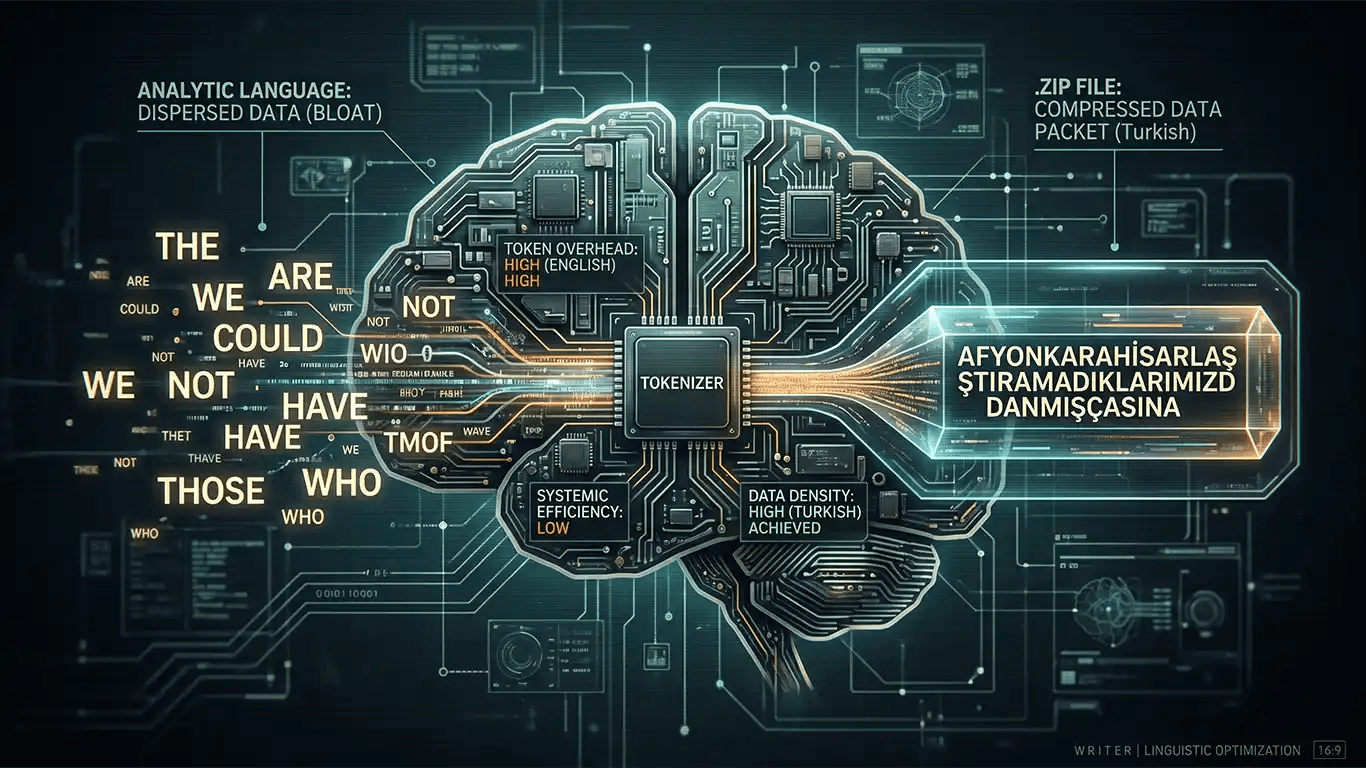
  • A futuristic schematic of a mechanical brain comparing "analytic language bloat" (scattered English words like "THE" and "HAVE") to a "compressed data packet" (a single, dense Turkish word). The image highlights the high data density and systemic efficiency of Turkish versus the high token overhead of English...
    Aug 21, 2025Development

    AI's Anglocentric Tokenization Tax

    English is the legacy COBOL of linguistics: bloated and redundant. While "visionary" developers burn compute on filler tokens like "the" and "of," agglutinative languages like Turkish operate as high-density .zip files. A single Turkish word functions as a compressed data packet; it packs entire sentences into a single root (pure systemic efficiency!). Yet, our "optimized" tokenizers still treat these elegant structures like legacy errors because they cannot fathom a world outside their own Anglocentric hubris...


    Read →
You've reached the end

© 2023 Mehmet Yildiz. All rights reserved.

Privacy PolicyTerms of Service