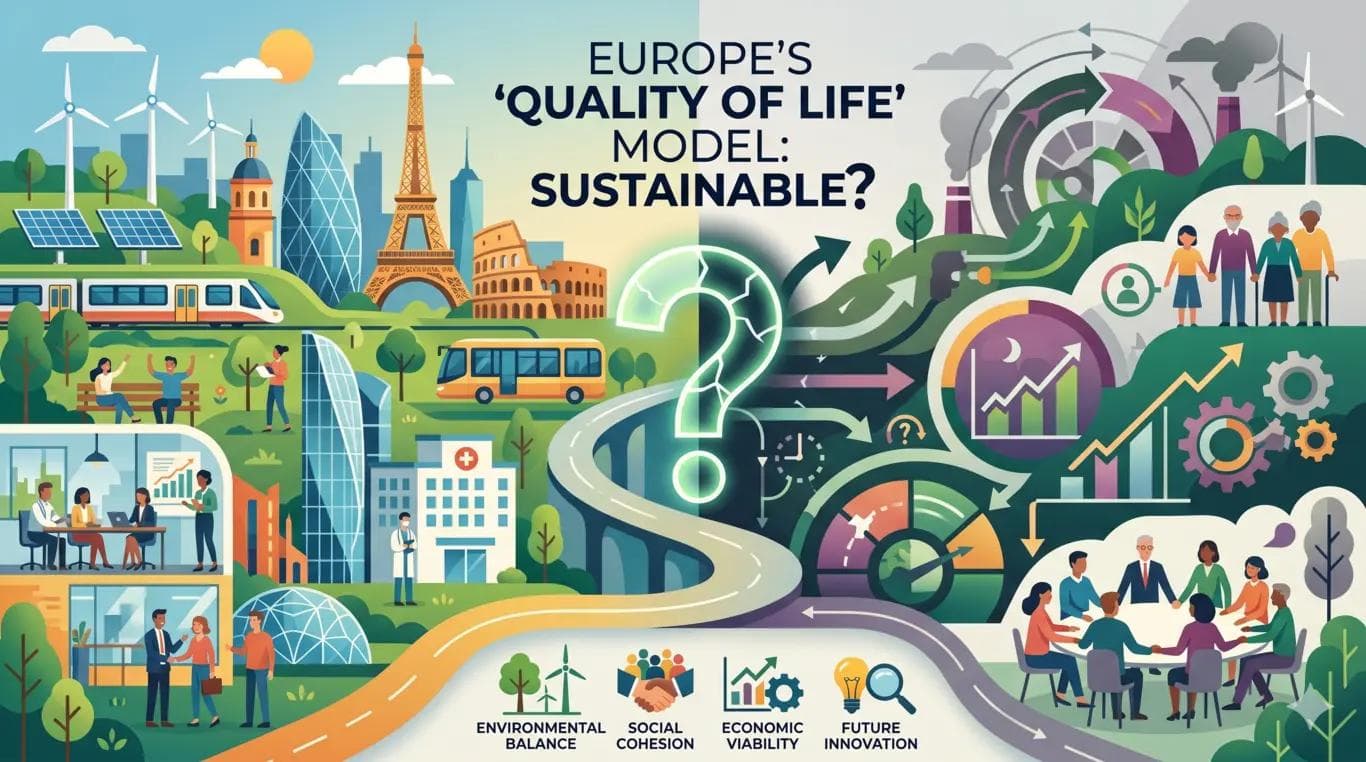
Europe's 'Quality of Life' Model: Sustainable?
The conceptual collapse of the European sanctuary
The European Union is currently confronting the structural exhaustion of its most cherished asset: the "Quality of Life" model. For decades, this model functioned as a sanctuary of social stability, predicated on a delicate equilibrium of high welfare spending, compressed income inequality, and a pioneering green transition. But this sanctuary was never a closed system. It was a subsidized ecosystem, thriving on the back of three external facilitators that have now vanished: cheap natural gas from Russia, an ever-expanding market in China, and a comprehensive security umbrella provided by the United States. And with these pillars removed, the mechanical foundation of the European way of life is undergoing multi-system failure.
The diagnosis is not new, but the 2024-2025 data indicates that the decline is accelerating from a manageable stagnation into a terminal "slow agony". While the United States and China have pivoted toward aggressive industrial policies and rapid technological scaling, Europe has remained entrenched in its role as a "world-class bureaucratic cage," prioritizing regulation over innovation and consumption over production. The result is a widening competitiveness gap that threatens the very social rights the bloc intended to safeguard.
To understand the trajectory of this decline, one must analyze the sustainability of the model through a heuristic of productive vitality. A society’s ability to maintain its quality of life is a direct function of its productivity and demographic health, weighed against the escalating costs of social maintenance and energy transitions.
                      [ Productivity * Demographics ]
Sustainability(EU) =  -------------------------------
                      [ Welfare Expenditure * Energy ]
When productivity growth stagnates—rising only 30% in Europe since 1993 compared to 60% in the United States—and demographics turn sharply negative, the numerator of this equation collapses. Simultaneously, the denominator is expanding as energy costs remain structurally higher than those of global rivals and the costs of an aging population reach a fiscal cliff. But the European political class has largely responded to this imbalance with "integrationist rhetoric" rather than the radical structural surgery required.
The Draghi Report and the autopsy of European competitiveness
In late 2024, the report by Mario Draghi, "The Future of European Competitiveness," provided the most exhaustive autopsy of the European economic model to date. Draghi’s 400-page strategic roadmap identifies an existential crisis: Europe faces lasting sluggish economic growth that threatens its prosperity and social welfare. The report is blunt in its assessment that the previous era of European growth is over.
The productivity chasm and the innovation abyss
The core of the European failure lies in its inability to capture the "fourth industrial revolution". While the US has created "from scratch" companies with market capitalizations over $10 billion at a rate five times faster than the EU over the last 50 years, Europe has become "a museum as a continent and a museum as a stock market". This is not merely a failure of imagination; it is a failure of capital.
Europe possesses significant scientific potential, but it consistently fails to transition "from patent to product". The innovation gap is exacerbated by a lack of risk-taking and a fragmented capital market that diverts €300 billion in European savings to the United States every year. And the data from 2024-2025 shows that this drain is only intensifying. Over one-third of European corporate "unicorns" now relocate abroad, primarily to the U.S., seeking the financial and training environments that the EU’s "bureaucratic cage" fails to provide.
| Investment and Growth Metrics (2024-2025) | European Union | United States | China |
|---|---|---|---|
| GDP Growth (15-year cumulative) | 6% | 82% | N/A (High) |
| Global Venture Capital Share | 17% | 57% | 21% (APAC) |
| Scale-up Capital per Firm | Baseline | 2x EU | Moderate |
| Annual Investment Need (Draghi Estimate) | €800 Billion | N/A | N/A |
The Draghi report quantifies the investment needed to close this gap at €750-800 billion per year, or approximately 5% of EU GDP. This is a massive requirement that the current fiscal framework is ill-equipped to handle. But the proposal for "joint European debt" to fund these common projects—a "secure European safe asset"—remains a point of intense political friction. Germany and other northern member states have repeatedly rejected the concept of permanent debt issuance, even as the European Court of Auditors criticizes the management of current instruments like NextGenEU.
The bureaucratic cage and regulatory overkill
A significant portion of Europe's competitive deficit is self-inflicted through a "flat-footed" response to expansive global industrial policies. The EU has prioritized being a "rule-maker" in sectors it does not lead, such as Artificial Intelligence. The AI Act, while aiming for safety, has created a "source of uncertainty" that deters investment.
And the cost of this regulation is a direct tax on productivity. Approximately 86% of EU firms employ staff dedicated solely to regulatory compliance. For small and medium-sized enterprises (SMEs), this cost averages 2.5% of turnover. When combined with energy costs that reached 4% of turnover following the 2022 shock, the cumulative burden on European industry becomes unsustainable.
| Regulatory and Operational Burdens (EU 2024) | % of Turnover / Impact |
|---|---|
| Compliance Staffing (SMEs) | 2.5% |
| Compliance Staffing (All Firms) | 1.8% |
| Energy Costs (Post-2022 Shock) | 4.0% |
| Share of implemented Draghi recommendations | 11.2% |
By January 2025, the European Commission presented its "Competitiveness Compass," a roadmap to restore dynamism based on Draghi’s analysis. But the implementation has been underwhelming. An audit by EPIC found that of the 383 recommendations made by Draghi, only 43 (11.2%) had been fully implemented within the first year. The findings underscore a continent that excels at "churning out world-class bureaucratic cages" while its rivals dominate the future of technology.
Energy dynamics: The cost of a green "Quality of Life"
The European "Quality of Life" model is inextricably linked to its energy consumption. Historically, a high quality of life has been associated with a high consumption of natural resources, and energy is a fundamental driver for both economic development and human development. But the rapid transition to green energy, while environmentally necessary, has immediately impacted the quality of daily life with direct consequences for the costs and comfort of living.
The paradox of renewable energy and happiness
Exploratory research published in 2025 reveals a troubling paradox within the EU’s energy transition. While final household energy consumption per capita is positively associated with happiness (r=0.661) and prosperity (r=0.541), the share of renewables in that consumption is statistically significantly but negatively associated with perception of happiness (r=-0.557) and life satisfaction.
This negative correlation is largely attributed to higher utility bills. The EU consumer remains at the center of the "energy market—quality of life—sustainable development" triad, yet they are the ones bearing the cost of the transition. An increased share of households in total energy consumption often correlates with a lower Gross Domestic Product per capita, suggesting that the "greening" of the energy sector has not yet translated into a prosperity gain for the individual.
| Energy-Quality of Life Correlations (EU) | Happiness (r) | Prosperity (r) |
|---|---|---|
| Household Energy Consumption | 0.661 | 0.541 |
| Share of Renewables in Consumption | -0.557 | -0.480 |
| Final Expenditures per Capita | 0.853 | 0.792 |
But the statistical significance of these negative associations highlights a fundamental truth: the "European way of life" is currently being eroded by the very policies intended to make it sustainable. Increased energy expenditures have led to a mix of reactions, including "migrating between suppliers" and "decreasing home temperatures" to save money. Energy is no longer a cheap enabler of lifestyle; it is a primary stressor.
The deindustrialization of the European core
The impact of high energy prices on the industrial sector is even more severe. Industrial electricity prices in the EU are twice as expensive as in the U.S. and nearly 90% higher than in China. For natural gas, the disparity is catastrophic: in 2025, industrial gas prices in the U.S. are less than a quarter of those in the EU.
This energy cost disparity is the primary driver of a "silent deindustrialization." Foreign direct investment (FDI) into the EU from non-EU countries collapsed from €7.7 billion in 2022 to just €218 million in the first half of 2025. European firms are retreating from global markets, with FDI outflows in the automotive supply industry dropping from €11 billion in 2023 to just €341 million in 2025.
The case of Volkswagen (VW) is illustrative. In September 2024, the largest industrial employer in Europe announced it was considering plant closures and layoffs for the first time in its history. While VW management cited high labor and energy costs, the reality is that the company’s "rear-guard battling" against the transition left it behind in terms of digitalization and innovation. The BYD Seagull, a Chinese EV costing $10,000, stands in stark contrast to VW’s lowest-priced plug-in, the ID.3, which costs over $16,000 in China.
But the VW crisis is not an isolated event. BASF, the German chemical giant, reported that while its standalone businesses delivered "superior earnings contributions," the overall Group EBITDA fell below outlook due to lower margins in upstream businesses and high energy costs. The German manufacturing sector output fell below pre-pandemic levels in late 2024, and analysts expect challenges to persist as EU gas prices remain structurally high.
The demographic fiscal cliff and the pension crisis
If energy costs are the immediate threat to the European "Quality of Life" model, demographics are its ultimate verdict. The European social model relies on a "pay-as-you-go" (PAYG) system where current workers fund the retirements of the elderly. But this system is facing a demographic fiscal cliff.
The vanishing "pension space"
Declining birth rates and rising life expectancy are straining the worker-to-retiree ratio. In countries like France and Italy, pension spending constitutes a significant portion of government expenditure, accounting for 14.7% and 15.5% of GDP, respectively. This is far above the European average of 12%. By contrast, the Netherlands and Sweden have lower proportions at approximately 10.7% of GDP.
The "pension space"—the fiscal leeway governments have to finance public pensions—is vanishing. France and Italy are expected to have zero pension space by 2030. Germany and Spain are in a slightly less critical position, but still face significant challenges. Germany has proposed a state-funded pension plan aimed at reaching €200 billion by 2036, financed through government loans, to alleviate the burden on the first pillar.
| Pension Sustainability Metrics (2025) | France | Italy | Germany | Netherlands |
|---|---|---|---|---|
| Pension Spending (% of GDP) | 14.7% | 15.5% | ~12% | 10.7% |
| Retirement System Deficit | 3% | 7% | 2% | 0% |
| Projected Pension Space (2030) | 0% | 0% | 10-25% | 10-25% |
| Worker-to-Retiree Ratio (Threshold) | < 2 | < 2 | < 2 | ~2.1 |
But the public remains resistant to reform. A December 2025 YouGov survey found that while 52% to 61% of respondents in Italy, France, Germany, and Spain acknowledge their state pension systems are already unaffordable, majorities (up to 83%) feel the amount retirees receive is too low. There is overwhelming opposition to raising the state pension age or reducing benefit amounts. In Germany, 65% oppose making people wait longer to claim their pension, even as the system approaches a "fiscal cliff".
The securitization of the economy and the end of the "Peace Dividend"
Compounding the fiscal pressure of aging is the "geopolitical shift" in EU spending priorities. Following the European Council conclusions of March 2025, all 27 Member States have been urged to reinforce overall defense and security spending while ensuring debt sustainability. This is an unprecedented move that signals the end of the era where the EU could rely on the U.S. security umbrella without significant cost.
The rearmament effort is likely to erode the European social model. Higher defense spending is expected to "erode welfare and public investment". In December 2025, the Commission’s communication on "Strengthening EU economic security" signaled a transition from a "value-based" economy to one guided by security principles. This shift threatens the quality of life by diverting limited fiscal resources from social investment to military-industrial complexes.
And the "synergy" between economic and defense security is not a given. The finances needed to reinforce the EU defense industrial base require a strong and open economy, which is currently undermined by energy costs and stagnation. Critics fear that this "obsession with deterrence" reflects a continuity with past crises—lofty integrationist rhetoric coupled with measures that entrench fragmentation and fiscal imbalance.
The "Sun Belt" vs. the Stagnant Core: A divergent future
While the traditional heart of the European project—the Franco-German engine—stagnates, a new economic geography is emerging on the continent’s periphery. This "European Sun Belt" consists of Poland, Greece, Portugal, and several former communist states that are demonstrating a dynamism missing from Paris and Berlin.
Poland: The emerging growth engine
Poland is the primary example of this divergence. While the Eurozone grew by only 6% in dollar terms over the last 15 years, Poland has accelerated its development with the aspiration of becoming the fastest-growing EU economy for the next decade. By 2025, Polish per capita GDP (PPP) is projected to reach 85% of the EU-15 average.
| GDP Growth Forecast (2025) | Projected Growth Rate (%) |
|---|---|
| Spain | 2.8% |
| Poland | 2.0% - 3.5% |
| Greece | (Strong recovery mentioned) |
| Germany | 0.3% - 0.5% |
| Eurozone Average | 0.9% |
But this growth is not uniform. Southern Europe, including Spain and Greece, has benefited from a post-pandemic tourism boom and employment growth, even as momentum begins to ease slightly. Spain's GDP is projected to grow by 2.8% in 2025, a stark contrast to Germany’s anticipated 0.5% increase.
This divergence creates a "geography of discontent" within the EU. While the "Sun Belt" offers sunny business prospects and pleasant weather, the stagnant core wallows in low-paying service jobs and an "elephantine welfare state". The workers in these "left behind" regions are increasingly drawn to radical-right populist parties, which capitalize on economic insecurity and cultural grievances. Trust in institutions is eroding, particularly in countries like Spain where the gap between macroeconomic improvement and the everyday experience of households remains wide.
The "Museum" Critique: AI, innovation, and the future of work
The Swedish Prime Minister warned in 2025 that Europe risks becoming a "museum" if it doesn't innovate in AI and deregulate. This critique is centered on the continent's failure to lead in the digital sector. Of the top 50 global tech firms, only three are in Europe; the list is dominated by Silicon Valley.
The AI Act and the innovation drain
Europe's response to the AI revolution has been primarily regulatory. While the US invests $209 billion in venture capital (57% of the world total), Europe invests only $62 billion (17%). US investors are willing to listen to "far-out ambitions," whereas European investors often hit their ceiling of imagination.
But the problem is also cultural. In Europe, "working hard" is often "actively uncool" or even "literally forbidden". In 2023, Americans worked an average of 1,796 hours annually, while Germans worked only 1,340 hours—a difference of 11 extra 40-hour weeks per year. This disparity is correlated with a model that prioritizes lifestyle over the intensification of capital, leading to stagnant productivity growth.
| Annual Working Hours (OECD 2023) | Average Hours per Worker |
|---|---|
| United States | 1,796 |
| France | 1,500 |
| Netherlands | 1,420 |
| Germany | 1,340 |
The Draghi report calls for a "regulatory pause" on AI rules to assess potential drawbacks, but the AI Act is already set to be fully applicable by 2027. Without a fundamental shift in how the EU handles high-tech innovation, it will continue to suffer from an "innovation drain," where its best researchers and start-ups relocate to the "exponential growth" environment of America.
The "European Social Model" as an enabler?
Defenders of the European model, such as Eurofound, argue that the social framework is not a burden but an "active enabler of sustainable economic performance". They posit that social investment yields returns measured in higher GDP and lower long-term state costs. But this "virtuous circle" requires well-functioning social dialogue and a labor market unhampered by structural inequalities—conditions that are increasingly rare in a fragmented EU.
And the 2025 data suggests that social matters have been "deprioritized" in the ongoing Multiannual Financial Framework (MFF) negotiations. "Defence and competitiveness are being prioritized at the expense of the EU's unique model of diversity, dialogue, solidarity and democracy". The "Quality of Life" model is being squeezed from both sides: it lacks the productivity to be self-sustaining and it is losing the political priority required to be subsidized.
Synthesis: Is the "Quality of Life" model sustainable?
The evidence gathered for the 2024-2025 period leads to a somber conclusion: the European "Quality of Life" model, in its current configuration, is mathematically and structurally unsustainable. The "lifestyle superpower" status was a luxury afforded by external factors that no longer exist.
The "Sustainability Gap" is defined by several converging crises:
The persistent gap between EU and US energy prices is driving energy-intensive industries out of the continent. The collapse of FDI into the EU is a direct signal of investor caution regarding the bloc's economic trajectory.
The worker-to-retiree ratio is falling below the critical threshold of 2.0 in the major economies of the stagnant core. The public's refusal to accept pension reforms, coupled with the rising costs of healthcare for the elderly, will lead to a "fiscal cliff" by 2030.
Europe has become a "regulatory superpower" but an "innovation desert." The bureaucratic cost of compliance is stifling SMEs, and the lack of a unified capital market prevents the scaling of new technologies.
The necessity of rearmament is cannibalizing the budget for social investment. The "securitization" of the economy will likely result in a less cohesive society as the "peace dividend" is replaced by defense-related austerity.
But the future is not uniform. The emergence of the "European Sun Belt" suggests that growth is possible within the EU framework, provided countries prioritize dynamism and exports over protective social formulas. Poland and Spain are demonstrating that peripheral dynamism can offset the stagnation of the core, but this divergence also threatens the unity of the Single Market as the "geography of discontent" widens.
Mario Draghi's warning of "slow agony" is the most likely scenario for the next decade. Without a massive, coordinated investment program—on the scale of €800 billion annually—and a total overhaul of the regulatory framework, Europe will continue to decline as a global economic actor. The "museum" will remain beautiful, but it will be increasingly expensive to maintain, and eventually, the visitors from the dynamic "exponential growth" economies of the US and China will be the only ones able to afford it.
The "European Way of Life" is a legacy asset. Like any such asset, if it is not reinvested in and adapted to new market realities, it will eventually be liquidated by the cold logic of global competition. As of 2025, the liquidation process is well underway. The only question that remains is whether the European political class has the courage to enact the "deep rethink of the social contract" that the IMF and others now deem essential. But given the 11.2% implementation rate of Draghi's recommendations, the answer appears to be negative. Europe is indeed a museum, and its "Quality of Life" model is the most prominent exhibit—elegant, historical, and increasingly unaffordable.