
The Wood Wide Web Spoke First: How Mycelium Fantasy Is Shaping Real Science
There is a peculiar sequence of events unfolding in biology right now. Scientists are confirming, with careful experimental rigor, mechanisms that science fiction writers described decades ago through pure intuition and narrative convenience. The mycelium network is the clearest example of this; a system so structurally elegant that storytellers reached it before researchers did, and the researchers are now grateful for the head start.
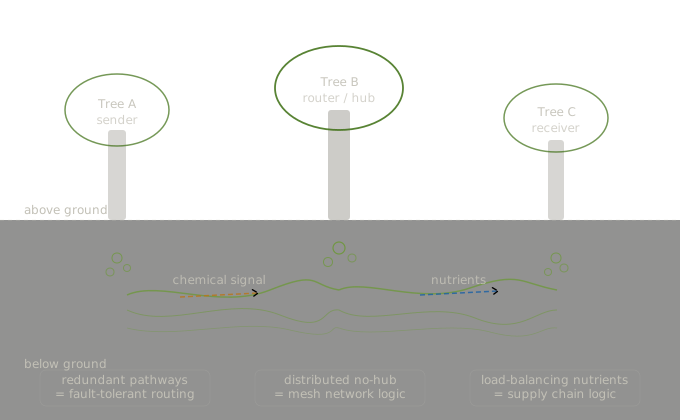
The basic fact is well established: fungal mycelium threads connect the root systems of trees and plants across hectares of forest floor, enabling the transfer of carbon, nitrogen, water, phosphorus, and what appear to be chemical distress signals. A tree under pest attack can emit signals that travel through this network; neighboring trees upregulate their own defensive chemistry before any pest reaches them. The forest is not a collection of competing organisms but something closer to a single distributed system with no central processor and no obvious protocol stack. It just works.
Where the stories got there first
Ursula K. Le Guin described planet-spanning biological communication networks in her fiction decades before mycorrhizal research entered the mainstream. Avatar's Eywa, absurdly maligned by critics for being "too convenient," was essentially a prescient description of mycorrhizal network topology rendered as spiritual metaphor. The first season of Star Trek: Discovery built an entire propulsion mechanic around spore-based mycelium networks, which was scientifically incoherent but conceptually interesting: the idea that a biological mesh distributed across the universe could serve as a traversal system borrowed precisely the right structural intuition from actual fungal biology.
These stories were not operating on evidence. They were operating on aesthetic sense, on the feeling that something so ancient and pervasive had to be doing something important. And the mechanism they converged on, distributed signal propagation through a meshwork with no hierarchy and no single point of failure, turns out to be exactly right.
That convergence is not a coincidence. It is worth asking why.
The network question
One useful lens is information theory. A mycelium network solves the same core problems that human network engineers spent the twentieth century solving: routing information through a system where individual nodes fail regularly, where the topology is constantly changing, where there is no authority to arbitrate disputes, and where the cost of transmitting a signal must be proportional to its value or the system collapses.
The internet, particularly at the TCP/IP layer, arrived at distributed packet routing through a remarkably similar logic. The early ARPANET designers wanted a network that could survive nuclear strikes; they needed something with no central hub, where the destruction of any single node would force traffic to reroute dynamically through surviving paths. Mycelium solved this problem several hundred million years earlier, and it did so without engineers or protocol specifications.
What mycelium does additionally, and what our networks currently do not, is maintain chemical memory. The network does not merely route; it appears to retain information about what passed through it. Some researchers describe this as a form of primitive learning; repeated signals along certain pathways may reinforce those pathways structurally, which looks suspiciously like synaptic strengthening in neural tissue. If this holds up under further scrutiny, it suggests that the distinction between a communication network, a memory system, and a transport infrastructure may be a category error that biology figured out was a category error a very long time ago.
What the physics might owe the mushroom
Here the inquiry gets genuinely speculative, which is where it gets interesting.
Some theoretical physicists working on quantum gravity and spacetime topology have noted structural similarities between mycorrhizal networks and certain models of spacetime at the Planck scale. This is not a claim that spacetime is made of mushrooms; it is a claim that the mathematical objects used to describe distributed information propagation in biological meshworks and the mathematical objects used in some loop quantum gravity models are formally similar. The universe, if certain approaches are correct, may route information the way forests do, redundantly, without hierarchy, through a medium that is itself the routing.
This remains speculative. But it is the kind of speculation that tends to produce productive research because it suggests looking for mechanisms in nature that have already solved problems currently considered unsolved in physics.
The technology transfer question
More grounded applications are already in motion. Urban transit planners have used mycelium network growth patterns to optimize subway route efficiency; a famous study placed oat flakes at positions corresponding to Japanese cities and watched mycelium connect them, producing a network topology remarkably similar to the actual Tokyo rail system, which was designed by humans over decades. The implication is uncomfortable: a fungus in a petri dish, optimizing for nutrient flow with no global awareness and no planning horizon, arrived at roughly the same solution as teams of engineers working with explicit optimization objectives.
Materials science is exploring mycelium as a substrate for self-repairing structures. The network rebuilds broken connections; if you could grow an electrical conductor or a structural material using mycelium-like growth rules, you would get a material that heals itself by default rather than by exception. That is a fundamentally different engineering paradigm than anything currently in production.
Neuromorphic computing researchers are paying attention because the mycelium network's apparent capacity to reinforce high-traffic pathways is a biological implementation of something they are trying to build in silicon: hardware that adapts its physical structure in response to use patterns, rather than running fixed circuitry and simulating adaptability in software.
The spoken word dimension
Spoken word poetry, as a form, does something that scientific papers cannot: it creates felt familiarity with a phenomenon before the phenomenon is fully understood. When a poet describes the forest as breathing together, as grieving together, as warning each other, they are not making a truth claim subject to peer review. They are building an intuition in the listener, a sense that connection and communication are properties of living systems generally, not special features of animals with brains.
That intuition turns out to be scientifically productive. Researchers who grew up with that aesthetic sense ask different questions than those who did not. They look for communication where a strictly mechanistic framework would not think to look. The mycelium story is partly the story of scientists who took a poetic intuition seriously enough to design experiments around it.
This is not an argument for abandoning rigor. It is an observation that imagination frequently precedes evidence, and that the quality of scientific curiosity is shaped by the cultural environment in which scientists develop. A culture that produces spoken word poetry about forest networks produces scientists who go looking for forest networks. The causal chain is indirect and diffuse, but it is real.
Where this leaves us
The mycelium network has already influenced network topology thinking, urban planning, materials science, and the edge of theoretical physics. It may yet influence how we think about distributed computing, self-repairing infrastructure, chemical computing, and the question of what counts as cognition.
None of these applications were designed. They emerged from people asking whether a mechanism that nature already built could teach them something. That question is easier to ask if you have already, through fiction or poetry or cultural exposure, developed a felt sense that nature builds interesting mechanisms worth studying.
The forest has been routing signals for four hundred million years. It would be genuinely strange if we did not look more carefully at the protocol...