Korean Entertainment's Global Ascent
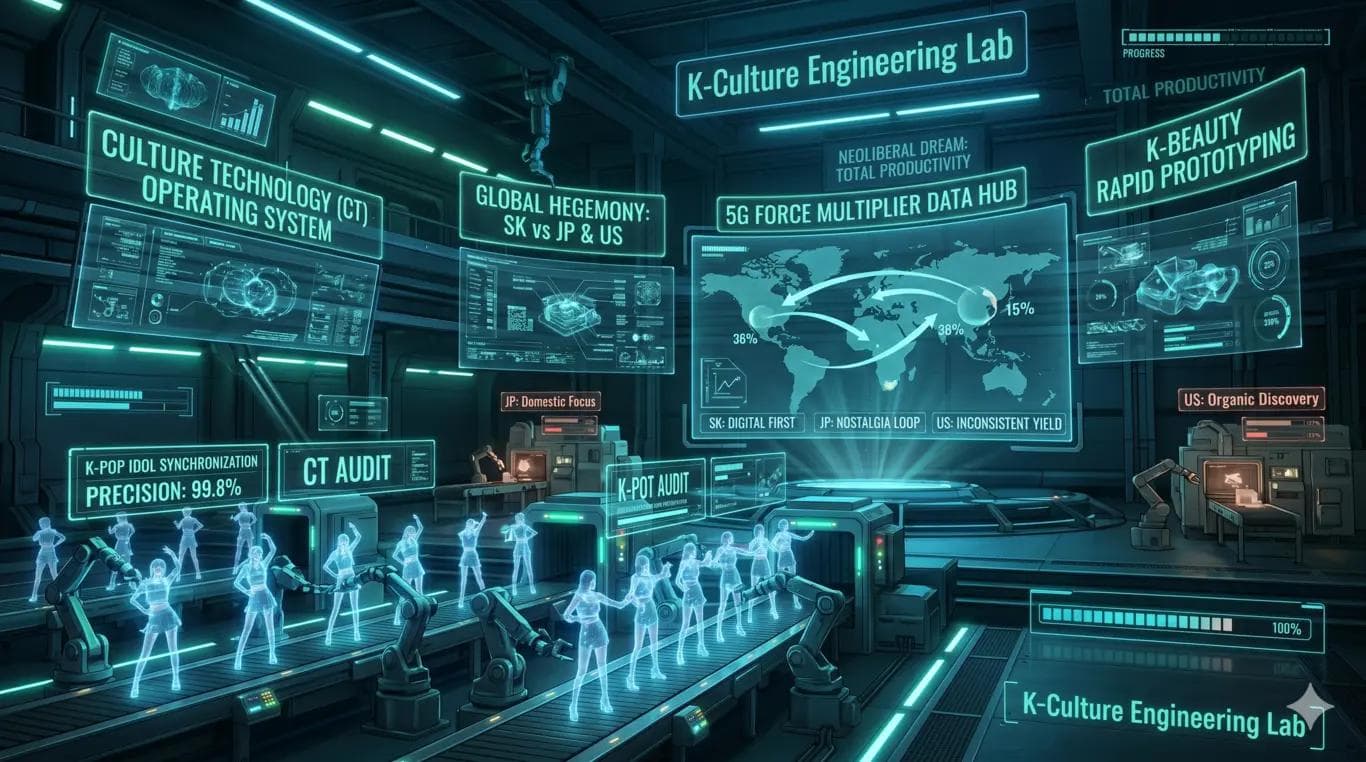
The shift in global cultural hegemony isn't some romantic accident born of "creative inspiration" or the mythical "muse." It is, quite frankly, a cold-blooded engineering triumph. While the United States continues to coast on the fumes of its legacy "independent discovery" model and Japan remains paralyzed by the nostalgic "Cool Japan" traps that keep its content locked in a domestic vault, South Korea has successfully manualized the production of cultural capital. This isn't art; it’s a Culture Technology (CT) audit, and the data suggests the West is losing the "yield" war.
If you’re still looking at BTS or Squid Game as mere entertainment anomalies, you’ve already failed the analysis. This is about the industrialization of the human variable.
The Infrastructure Play: Mobile-First Hegemony and the 5G Force Multiplier
The rise of the Korean wave (Hallyu) is inextricably linked to a perfectly timed infrastructure pivot toward the mobile-first economies of East and Southeast Asia. While Western labels were still trying to protect archaic radio play-listing and legacy streaming royalties, Seoul-based agencies were optimizing for the "snackable" content demands of a 5G-saturated landscape.
- Connectivity as a Catalyst: In Southeast Asia, internet penetration has surged past 70%, with daily social media usage averaging 3.5 hours. Korea didn't just provide content; they provided the correct file format for this demographic’s hardware.
- The 5G Advantage: With South Korea’s domestic 5G coverage exceeding 95%, they used their own population as a beta-test for AR-integrated fan experiences and high-bitrate mobile engagement.
- And this is where the divergence begins. The West treats the internet as a distribution channel; Korea treats it as the primary operating system.
But the hardware is only half the story. The true "engineering" happens within the trainee systems—a process that treats human performance with the same clinical precision as a semiconductor wafer.
Culture Technology (CT): Manualizing the Aesthetic
The "Culture Technology" model, codified by Lee Soo-man in the late 90s, essentially turned the "artist" into a standardized production unit. In the US, you hope a talented kid gets discovered in a garage. In Korea, you manufacture the talent through a rigorous R&D pipeline that removes the "unreliability" of the human element.
| Metric | US Model (Organic) | Korean Model (Industrial/CT) |
|---|---|---|
| Input Quality Control | Inconsistent (Self-taught/Viral) | Standardized (10-year Trainee Cycles) |
| Market Adaptability | Reactive (Trends-based) | Predictive (Data-driven localized units) |
| Asset Versatility | Specialist (Singer OR Actor) | Multidisciplinary (Integrated Media Asset) |
| Risk Management | High (Dependence on "Artist" whim) | Low (Contractual/Systemic control) |
This system produces individuals who are not just "performers" but are multidisciplinary assets integrated into the social fabric. They are trained in media ethics, language acquisition, and social engagement long before they ever step onto a stage. And this is the critical point: they are developed to be "socially education-ready." Through variety shows and "edu-tainment" formats, these idols are used to drive engagement and experience to a younger demographic, effectively training the next generation of consumers on how to interact with the brand. It’s a closed-loop feedback system that the West, with its obsession with "authenticity," simply cannot replicate.
K-Beauty and the Rapid Prototyping Paradox
The visual "perfection" of the entertainment industry was never going to stay confined to the screen. It was the ultimate lead-gen tool for the K-Beauty sector. By 2024, South Korea has positioned itself as the world’s third-largest cosmetics exporter, but the "how" is more important than the "how much."
The Korean cosmetic industry operates on a "Quick-Response" manufacturing model. Using Original Design Manufacturers (ODMs), they can move a product from a "concept" seen in a K-drama to a global shelf in under six months. Compare this to the sluggish, 18-month cycles of legacy French or American brands.
And let’s be direct: the rise of "glass skin" isn't a trend; it's a technical specification. By standardizing beauty through the high-definition lenses of mobile content, Korea created a global demand for a specific "look" that only their chemical engineering (the products) could satisfy. But if you think this is about "self-care," you’re missing the cynicism. It’s about the commodification of the face as a digital asset.
The ROI of "BTS-nomics" vs. The Western Bottleneck
The economic impact of this cultural engineering is staggering. The expected 5.5 trillion won contribution of BTS to the Korean economy upon their 2026 return isn't just about ticket sales. It’s about the "fandom multiplier."
In the traditional Western model, a fan is a consumer. In the Korean model, a fan is a volunteer marketing department, a data point, and a stakeholder. The return on investment (ROI) here is maximized because the "product" (the artist) is essentially a platform for other products (fashion, tech, tourism).
But there is a "cynical" reality behind this efficiency. To achieve this level of content quality and engineering dominance, the "human unit" is often subjected to conditions that would break a traditional Western artist. The "idol" is a property of the system, governed by "morality clauses" and rigorous schedules that prioritize the brand over the individual. It is the ultimate neoliberal dream: total productivity, zero downtime.
Conclusion: The Future is Virtual (And We Aren't Ready)
Japan failed because it stayed "analog" in its soul—protecting copyrights until the content became irrelevant. The USA is failing because it values "disruption" over "discipline," leading to a fragmented market of one-hit-wonder influencers who lack the technical stability of a trained Korean asset.
South Korea has already moved past the human bottleneck. They are now pivoting toward AI-integrated "Virtual Idols" and Metaverse IP that doesn't need to sleep, eat, or sign a contract. While we are still debating the "ethics" of AI in Hollywood, Seoul is busy coding the next generation of digital hegemony.
If we don’t stop treating culture as a "feeling" and start treating it as a technical supply chain, we are going to find ourselves as mere consumers in a world where every "vibe" we feel has been pre-calculated in a Seul office building. And frankly, looking at our current output, we probably deserve it.