Galatasaray ve Global Futbol Ekosisteminin İllüzyon ve Pragmatik Gerçeklikleri
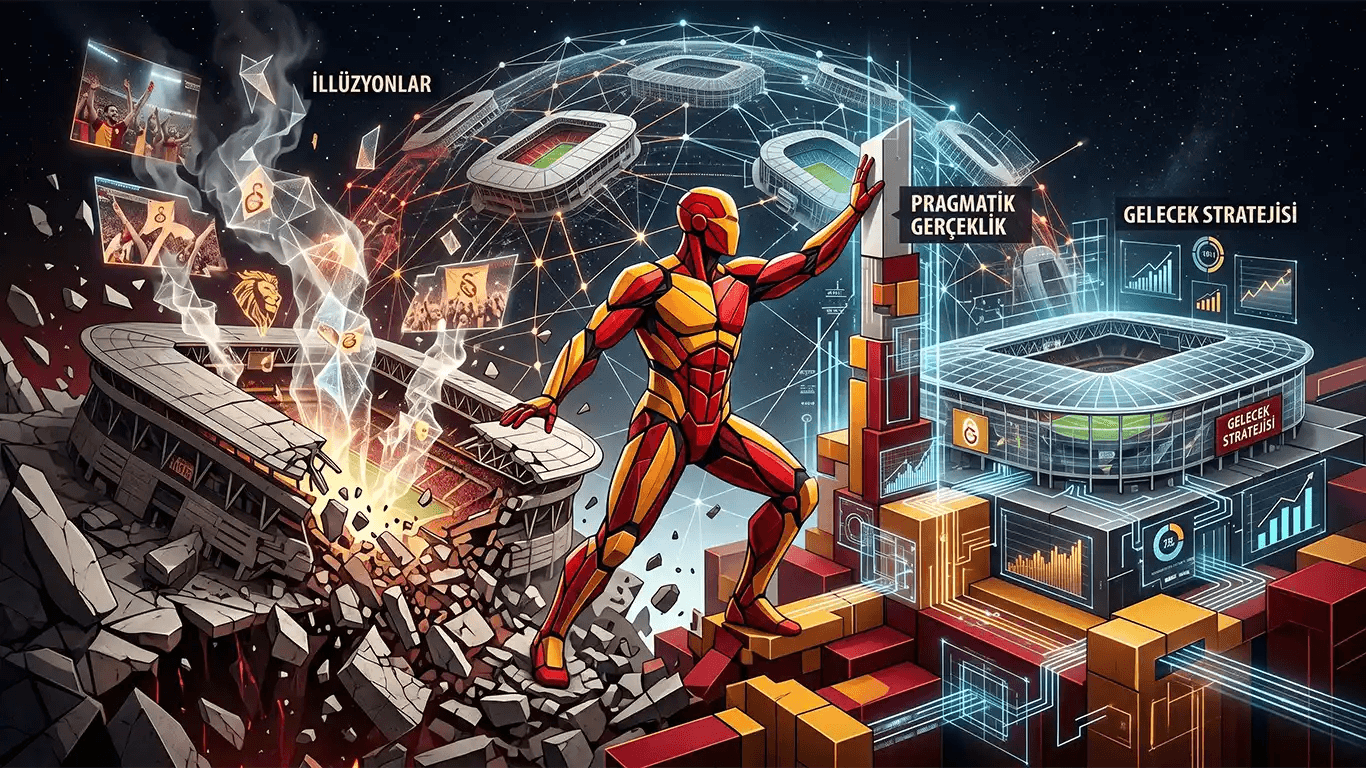
Consider these claims: Turkish football clubs are said to have "leapt into a new era," gained financial independence, and undertaken "visionary" projects capable of competing with European giants. This is a huge lie and a fundamental misconception. The modern sports industry ceased long ago to be an arena manageable by emotional rhetoric, fan populism, or bureaucratic grandstanding; this ecosystem is now a mechanical system built on strict profit margins, data-driven supply chains, and a ruthless battle for market share. The structural reality in Turkey, however, is entirely based on incompetence, corporate greed, and short-term, day-saving operations. If the foundation of a system is rotten, the "new generation" stadiums you build or the "digitalization" slogans you chant are no different from cosmetic patch packages applied to a collapsing software. While people continue to consume these superficial fixes as if they were a real product, the bureaucratic sluggishness in the background continues to erode the system from within...
This report analyzes, specifically for Galatasaray Sports Club, how a sports company attempts to balance on the brink of structural collapse; how far it has deviated from the system architectures of rationally managed institutions like Real Madrid, Benfica, and Ajax; and what integration into global networks such as the UEFA Champions League and FIFA Club World Cup truly means, all with mechanical detachment. Beyond corporate arrogance, a pragmatic picture will emerge where numbers and system logs do not lie...
The Financial Balance Sheet Illusion and the "Debt-Free" Theater
A company's success is not measured by the heroic stories told by executives on television screens, but by the net operating profit and borrowing costs found between the lines of audited consolidated balance sheets. When examining Galatasaray's Public Disclosure Platform (KAP) data for the 2024 and 2025 periods, it is clear that assets are artificially inflated by hyperinflation and real estate revaluations. The jump in fixed assets from 3.4 billion TL at the end of 2022 to 35.5 billion TL in September 2025 is not the work of operational genius, but a macroeconomic anomaly and an accounting illusion. The real metric to look at is the company's core production cycle. As of the end of 2024, the company's revenue was reported as 11 billion TL, while the cost of sales reached 12.6 billion TL. This means the system consumes more than it produces, and the main operating cycle structurally generates losses (as if this were something to boast about!).
The exit from the Banks Association agreement, the management's biggest source of pride, is being marketed as a financial victory. However, according to fundamental macroeconomic rules, debt is not a penalty; it is a pragmatic leverage that should be used depending on the macroeconomic environment and the return on investment (ROI). The Real Madrid example shows how this mechanism is operated correctly. The Madrid management invested a total of 1.347 billion Euros for the reconstruction of the Santiago Bernabéu stadium and used a massive loan for this (unpaid loan balance as of 2024/25 is 1.132 billion Euros). Madrid is not trying to hastily and proudly close this debt; on the contrary, it is transforming this debt into a massive cash engine that generates 310 million Euros in specific stadium revenue annually. Despite the debt's amortization and financing expenses being reflected in the income statement (P&L), the club has reached its highest EBITDA figure in history, 243 million Euros.
Galatasaray, on the other hand, is creating a "zero debt" illusion by consuming its cash reserves or real estate revenues (i.e., the club's future capital) to exit a structured credit spiral that has become cheaper in real terms due to the depreciation of the Turkish Lira. Being debt-free is not a success for a company operating with negative margins; it is an admission of lack of vision and an inability to convert acquired capital into production. Cash that should be spent on global monitoring networks, analytical software, or technology integration is being used merely to clean up bank balance sheets and save the day...
| Financial Metrics | Galatasaray (KAP End of 2024) | Real Madrid (2024/25) | Operating Paradigm |
|---|---|---|---|
| Total Revenue | ~11 Billion TL | €1.185 Billion | Local vs. Global Distribution Network |
| Cost of Sales / Expense | ~12.6 Billion TL | Personnel Expense Ratio 43% | Negative Margin vs. Sustainable Scaling |
| Debt Management Approach | Claim of Debt-Free by Liquidation | Growth Leverage with €1.132 Billion Loan | Saving the Day vs. Structural Leverage |
| Profitability / EBITDA | Operating Loss (Cost > Revenue) | €243 Million EBITDA | Consumption-Oriented vs. Production-Oriented |
Bureaucratic Bloat and the Tale of Law No. 7405
The decay of the system stems not only from the incompetence of club managements but also from the archaic functioning of Turkish sports bureaucracy. The state, by enacting Law No. 7405 on Sports Clubs and Sports Federations, supposedly introduced a "balanced budget requirement" for sports joint-stock companies and aimed to impose financial discipline on clubs. This move is no different from installing an external "antivirus" program on a collapsed operating system with broken core mechanics. Clubs view these legal restrictions not as a structural reform, but as new bureaucratic obstacles to circumvent. Balanced budgets are created on paper through dubious cash inflows disguised as sponsorships, real estate valuations, and inflated balance sheets. True innovation is not artificially restricting expenditures by law, but rather freeing and incentivizing the production mechanism through law.
The bureaucracy's primary focus is self-preservation. The corruption within the Turkish Football Federation (TFF) is the clearest evidence of this. The recently uncovered betting scandal demonstrates that the system is mathematically rigged. Investigations revealed that 149 match officials were suspended, 371 active referees were found to have betting accounts, and one official even placed over 18,000 bets. To speak of fair competition, brand value, or structural growth in an environment where referees manage a league they bet on is sheer madness. Galatasaray or any Turkish club cannot market its product globally by remaining in such a toxic and opaque local ecosystem. The core software code is infected; attempting to package and market this defective product with new and expensive transfers is nothing short of consumer fraud...
Core Gameplay Loop: The Stadium is Not Concrete, It's an Operating System
In the gaming industry, if the core gameplay loop is broken, adding new cosmetic outfits to characters won't save the game. A football club's core loop is also not just about a 90-minute match played on the field. System optimization must encompass the entire consumption chain, from the moment a fan steps into the stadium to their digital interaction after the match. Real Madrid becoming the only club in history to exceed the 1.185 billion Euro revenue mark twice in the 2024/25 season is not a result of luck on the field, but of a ruthless system design.
The Madrid management has transformed the stadium from a public building open one day a week into a multi-purpose hardware that generates money 365 days a year. Thanks to retractable roof and foldable pitch technology (hardware upgrades), the Santiago Bernabéu hosts NFL games, international concerts, corporate events, and a massive food and beverage (F&B) ecosystem. As a result, the club's recurring revenue from capacity and commercial operations (excluding seat licensing) increased by 38% compared to the previous year; total matchday revenues doubled, exceeding the 248 million Euro mark.
In contrast, Galatasaray's stadium is managed with an entirely archaic operating model, as a legacy system. While European clubs maximize commercial revenues (matchday yield) from fans per match, Galatasaray earns only 72 Euros per match, lagging far behind clubs like PSG (137 Euros). The inability to create a continuous economy around the stadium, the outsourcing of VIP hospitality services to simple suppliers, and the trivialization of in-stadium commerce mean that the club throws away millions of liras in potential profit every match day. Managers selling stadium naming rights for a few years and using the upfront cash to transfer "star" players at the end of their careers (and presenting this as a vision!) is nothing short of economic suicide. The stadium is not a passive billboard; it must be an integrated living, retail, and data collection center...
Infrastructure as a Supply Chain: Production Line or Public Relations?
In the software world, companies that cannot produce their own open-source code or core technology and constantly buy ready-made modules from outside are doomed to bankruptcy in the long run. The exact equivalent in the football industry is clubs' youth academies (infrastructure). Institutions like Benfica and Ajax manage their academies not as emotional homes, but as data-driven "supply chains" measured by strict performance metrics. CIES data confronts us with the naked truth: In the last decade, Benfica earned 589 million Euros, Ajax 454 million Euros, Chelsea 442 million Euros, and Lyon 423 million Euros from the sale of academy players. Benfica's revenue in the last five years alone is 367 million dollars, and transfers like João Félix (135 million dollars) and Rúben Dias (75 million dollars) are high-margin export products of this system.
Where does Galatasaray stand in this equation? A colossal nothing. Galatasaray's global transfer revenue from youth academy production is, quite literally, a statistical margin of error compared to these clubs. The club management claims to have made significant investments in infrastructure by building the new Kemerburgaz Metin Oktay Facilities; they present physical amenities such as "cinema halls, resistance pools, and technical analysis rooms" as sources of pride to the press. However, concrete, artificial turf, and expensive screens do not create a production system on their own. Even if you paint the walls of an old factory and put new machines inside, the quality of production will not increase as long as the factory's engineers work with the same archaic mindset and incompetence.
In Turkish football, infrastructure problems stem not from a lack of facilities, but from nepotism, poor personnel management, unscientific athlete selection, and short-term championship pressure. Galatasaray's academy, instead of being a talent supply chain with an algorithmic development model, has turned into a bureaucratic waiting room where former footballers or management cronies are employed. While Ajax discovers a player at 15, gives him a systematic tactical installation (software install), and sells him for 60 million Euros at 21; Galatasaray sends players of the same age group to the senior team physically weak, tactically ignorant, and mentally fragile. The result? The senior team goes and ties millions of Euros in salaries to 32-year-old European players every transfer window to "save the day." This is not a business model; it is a spiral of bankruptcy creating a structural foreign trade deficit...
| Club Academy | Last 10 Years Sales Revenue | Production Model Summary (Pragmatic Analysis) |
|---|---|---|
| SL Benfica | €589 Million | Global talent scouting, data-driven algorithm development, high-margin exports. |
| AFC Ajax | €454 Million | Systematic philosophy, mechanical tactical training, early senior team integration. |
| Chelsea FC | €442 Million | Intensive loan system, use of young players as financial leverage. |
| Galatasaray | Negligible | Archaic training methods, insufficient vision, zero senior team integration, import dependency. |
Global Ecosystem Traps: UCL and Club World Cup
Among managers and fans in Turkey, Champions League (UCL) participation is seen as a magic formula that will structurally save clubs. This is akin to a gambler believing they can pay off ten years of debt by winning a single big hand. In reality, UEFA's 2.43 billion Euro distribution model designed for the 2024-2027 cycle is a mechanical barrier designed to protect the hegemony of elite European clubs. In the new distribution model, revenues are divided into three main pillars: 27.5% participation share, 37.5% performance-based payments, and a new "value pillar" amounting to 35% (approximately 853 million Euros). This value pillar is an entirely monopolistic structure based on clubs' historical achievements and broadcasting pool values. In other words, the system transfers tens of millions of Euros in guaranteed capital to clubs like Real Madrid or Bayern Munich without them even stepping onto the field, while forcing "peripheral" clubs like Galatasaray into a high-risk struggle dependent solely on instantaneous sporting success.
Even more critical and striking is the 32-team FIFA Club World Cup (CWC) format to be held in the USA in 2025. This new playground for global football capital is a massive ecosystem with 1 billion dollars in broadcasting rights from DAZN and a total revenue of 2 billion dollars. The prize pool has been set at a full 1 billion dollars; just a group stage victory earns 2 million dollars, and the championship brings in 40 million dollars. To participate in this tournament, one must win the UEFA Champions League during the four-year period between 2021-2024 or rank among the top in UEFA's strict coefficient ranking. Clubs like Chelsea, Manchester City, Real Madrid, and Bayern Munich have already secured their places in this asymmetric war.
If Galatasaray cannot regularly integrate into such global organizations, the financial gap between it and its rivals will grow geometrically. However, the real danger lies here: instantaneous cash inflows accidentally obtained from these tournaments turn into a destructive weapon rather than a development tool in the hands of visionless Turkish managements. This incoming hot money is buried in the massive salary budgets of so-called "star" transfers (operational expenditure/OPEX) to appeal to fans, instead of being used to establish the club's technological infrastructure (capital expenditure/CAPEX) or develop data monitoring networks. This action is equivalent to a company canceling its entire R&D budget and spending all its cash on temporary and superficial advertising campaigns. The result is always the same: money runs out, stars age, and the system collapses...
| 2025 FIFA CWC Prize Mechanism | Amount (USD) | Structural Impact |
|---|---|---|
| Total Prize Pool | 1 Billion Dollars | Transfer of global capital to elite clubs. |
| Participation / Expectation Share | Variable by Participation | European Club Association (ECA) domination. |
| Group Stage Victory | 2 Million Dollars per Match | Single match revenue exceeding local league revenues. |
| Championship Prize | Additional 40 Million Dollars | Rich clubs becoming even more inaccessible. |
Real Technology Investment vs. Cosmetic "Social" Add-ons
Using the word technology as a marketing buzzword is one of the biggest frauds in today's corporate world. Galatasaray's so-called "digital transformation" vision consists of simple CRM data collection projects prepared by university clubs, creating short-term cash by selling cryptocurrency (tokens) to fans, or boosting engagement on social media. Commercializing fan loyalty and data does not mean sending them a few SMS messages a month and trying to sell jerseys. This is squandering industrial potential.
Real technology and innovation investment is structured with a ruthless return on investment (ROI) calculation. Real Madrid Next (the club's venture capital and innovation arm) does not limit itself to football but directly invests capital in start-ups focused on e-health, athlete performance optimization, audiovisual content production, and cybersecurity. Even more striking is Real Madrid's "Madrid Innovation District" (MID) project, signed with the Madrid local government. The club is transforming the 85-hectare area around Ciudad Real Madrid into a massive technology and R&D hub. According to PwC's report, this area will contribute 1.2 billion Euros annually to regional GDP and create 23,000 permanent technology jobs. Real Madrid has ceased to be merely a football club that wins matches; it has transformed into a trust-like technology company that processes data, real estate, and human capital. This is the fundamental reason why US private equity funds and venture capitalists are flocking to football clubs in the European market (such as Clearlake acquiring Chelsea or Ares Management partnering with Atletico Madrid); elite clubs are now valued as global content, data, and performance companies.
So what is Galatasaray doing? It cannot convert the data of its massive and fanatical supporter base into a meaningful product; it cannot turn its brand value into an investment. 90% of the activities companies undertake under the name of "corporate social responsibility" (CSR) are superficial advertising campaigns conducted purely to polish their image and maintain warm bureaucratic relations. Galatasaray organizing cinema events with children in schools or providing food supplements to foundations is a social band-aid, not a structural development model. True social responsibility is not playing corporate philanthropy; it is building production areas that will strengthen the economic infrastructure of society.
If Galatasaray is to convert its brand value into an investment, it must channel the one-time rent revenues obtained from real estate projects (like Florya or Riva) into ventures producing sports technologies (sportstech), biomechanical monitoring systems, global data mining algorithms, and artificial intelligence. Selling land to contractors and using the proceeds to buy an aging striker is not a "vision"; it is a betrayal of intergenerational wealth transfer. Capital only transforms into a true asset when invested in self-renewing and scalable technological ecosystems...
Pragmatic Reality and Future Projection
The source code of the system is evident; the price of emotional decisions, populist management, and day-saving financial illusions will be paid sooner or later. Galatasaray management must set aside the "world brand" rhetoric, hollow bureaucratic victories, and matchday excitement at the stadium, and confront a harsh mathematical reality. The formula for how the club can ascend to higher levels does not lie in a magical tactical formation or the arrival of a popular coach; it lies in the board of directors returning to mechanical operating principles, data-driven supply chains, and zero-tolerance profit margins.
If the system continues with its current bureaucratic sluggishness, an unproductive and nepotism-ridden infrastructure model, a lack of vision that mistakes technological development for a simple CRM program, and a mindset that views the stadium merely as a cost center where matches are played; short-term foreign currency inflows accidentally obtained from the Champions League or Club World Cup will only postpone the system's inevitable collapse by a few more years.
A true structural revolution involves transforming the club into a technology and content platform managed with ruthless profit expectations, designing the academy as a data and export factory, making the stadium a 365-day operational hardware, and taking all operations out of the hands of incompetent bureaucrats to be managed by mechanical algorithms and rational professionals. Otherwise, every "historic" achievement or every loan agreement made will merely be a harbinger of a larger and more devastating wave of bankruptcy...