
Kurumsal Tembelliğin Evrensel Tarihi ve Aristo Çöplüğü
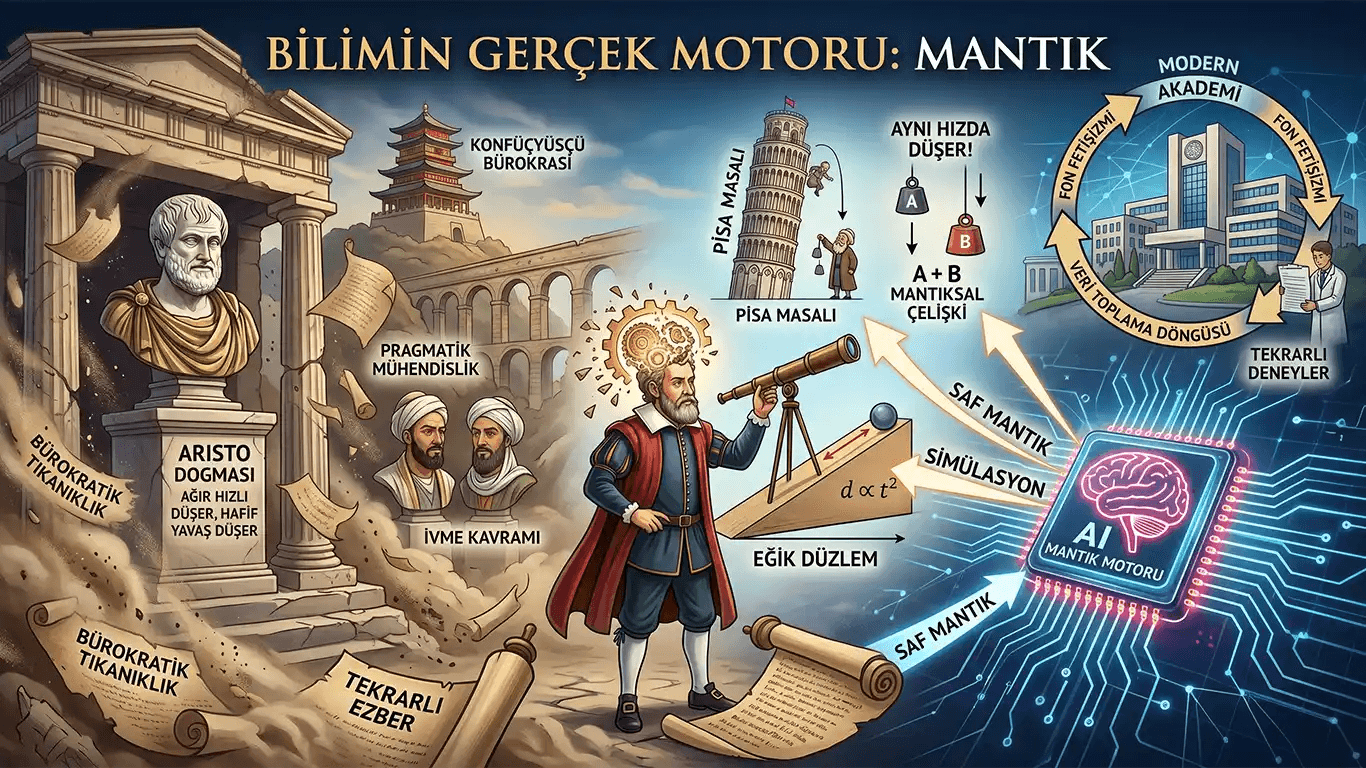
Consider these claims. Modern academia and the popular science industry market to us that science only progresses through "experiments" with massive budgets and that everything must be proven in laboratories. This is a complete fabrication. The greatest intellectual leaps in human history did not occur in trillion-dollar facilities; they happened in isolated minds that saw the internal contradictions of systems, shattered corrupt institutional dogmas, and used pure logic. Take Aristotelian mechanics: This system, blindly worshipped by institutional "scholars" for over a thousand years, claimed that heavier objects fall faster than lighter ones. The average academic clung tightly to this lazy assumption because it preserved their status quo and prevented them from making a real analytical effort.
A Global System Error: Mechanics in China, Rome, and the Islamic World
However, this institutional decay and the logical war waged against it are not unique to Europe. Reading history solely as a Eurocentric tale is to overlook the fundamental flaws of the system. Let's go much further back, to Ancient China. Centuries before Aristotle, Mozi and his followers (the Mohists) built an immense logical framework on optics and mechanics. They defined force, motion, and fundamental physical laws using a strict deductive method. So what happened to them? The bureaucratic apparatus of the Han Dynasty intervened. The "Confucian" system, which prioritized loyalty to the state, rituals, and rote learning, saw the dangerously analytical and questioning minds of the Mohists as a threat. The state bureaucracy sacrificed mechanical truth for hierarchical conformity, and China's scientific momentum was halted for centuries.
A similar systemic pragmatism (and ultimate collapse) can be seen in the Roman Empire. Romans are often underestimated for not producing great theoretical physicists. This is a huge misconception! Roman engineers (names like Vitruvius) largely discarded the "lofty" and detached theoretical philosophies of the Greeks. Why? Because you cannot build massive aqueducts, roads, or the dome of the Pantheon with Aristotle's speculative nonsense. The Romans focused on material science, tolerance margins, and iterative optimization instead of theoretical chatter. However, their pragmatic system also eventually collapsed due to the economic complacency brought by cheap slave labor and a cumbersome imperial bureaucracy. When human labor was so cheap, there was no logical incentive left to invest in mechanization and mechanical innovation.
The ones who truly rewrote the system's code were the analytical minds of Islam's Golden Age. Western academia loves to erase this supply chain from its curriculum (it's much more profitable for their "European Miracle" marketing!). In the 11th century, Ibn Sina (Avicenna), by developing the concept of "Mayl" (impetus/momentum), logically proved that an object moving in a vacuum would continue to move indefinitely unless an external force (like air resistance) stopped it. Ibn Bajjah (Avempace) formulated the mathematical relationship between speed, force, and resistance. These were critical software patches applied to the crumbling Aristotelian physics. Unfortunately, just as in China, after a while, theological and bureaucratic dogmas poisoned this environment of free analytical thought, and dogmatic repetitions replaced innovative logic.
What Europe called the "Enlightenment" was, in fact, nothing more than the re-compilation of this Eastern data. When Jean Buridan in the 14th century or Giambattista Benedetti in the 16th century were on the scene, they didn't invent anything from scratch; they cornered that lazy Aristotelian logic with centuries of accumulated knowledge. Benedetti, long before Galileo, had demonstrated through a pure thought experiment that two objects of different weights should fall at the same speed. The system was cracking on all sides, and all that was needed was a chief engineer to combine all this data and deliver the fatal blow to the system.
Aristotle's "Blue Screen": Galileo and the Logical Paradox
This is where Galileo's genius lies. He didn't build fancy laboratories; he found the "error code" within the massive data pile before him and collapsed the entire Aristotelian system upon itself. That famous "connected bodies" paradox is a perfect marvel of logic. Against Aristotle, who claimed that a heavier mass (A) should fall faster than a lighter mass (B); the idea of connecting A and B with a rope... According to Aristotelian logic, the slower B should slow down the faster A; thus, the combined system (A+B) should fall slower than A alone. At the same time, since the total (A+B) is heavier than A alone, it should fall even faster! An object cannot fall both faster and slower simultaneously. Galileo, so to speak, made the old physics crash with a blue screen by collapsing the system with its own rules.
Pisa Tales and the Engineering Ingenuity of the Inclined Plane
The famous story of "dropping cannonballs from the Leaning Tower of Pisa" that comes into play at this point is a cheap public relations fabrication presented for mass consumption. People don't like complex mathematical proofs; they prefer spectacular heroic theatrics. Trying to measure gravity by dropping cannonballs from the Leaning Tower of Pisa without a precise digital measuring device is foolish. Air resistance and human reaction time contaminate all data during that brief moment of free fall. Galileo was a pragmatic man who knew the limits of his equipment very well.
His actual physical solution was the inclined plane experiment, which solved the problem by circumventing it. Galileo "diluted" the acceleration of gravity using an inclined surface and spread the fall over a measurable time frame. He definitively proved that the distance covered by bronze balls he rolled down a smooth groove was proportional to the square of the elapsed time ($d \propto t^2$). He also used a water clock to measure time. But what should be noted here is this: This physical setup was not established to discover something new; it was merely a simple physical confirmation of an equation Galileo had already solved in his mind with pure logic. The real work was done in the mind.
Academic "Data Collection" Fetishism and Modern Resource Waste
Now let's adapt these historical facts to today's "experiment"-fetishizing educational and scientific institutions. Modern academia has transformed into a massive resource-wasting machine under the guise of the "scientific method." Trillions of dollars in laboratories, particle accelerators, and endless "data collection" rituals... University administrations need tangible, photographable, and media-resonant physical projects to maintain their status and secure funding. The system does not reward a thinker who makes breakthroughs with pure logic at a desk; instead, it funnels millions into massive bureaucratic research centers that employ hundreds of assistants like slaves on minimum wage and produce no revolutionary theories.
The situation is even more dire in educational institutions. Students are made to perform absurd and time-wasting experiments to "rediscover" physics or chemistry laws proven centuries ago, simply because the "curriculum" dictates it. If you correctly understand the fundamental parameters, macroeconomic incentives, or system architecture, you can already deduce the outcome. There's no need to physically collide everything or fill out millions of surveys. However, today's researchers prefer to inflate publication counts (and, of course, pocket funds!) in endless cycles of "empirical evidence" instead of producing practical results.
Silicon Minds and the Renaissance of Pure Logic
It is precisely at this point that Artificial Intelligence (AI) and Large Language Models (LLMs) have the potential to cleanse this decay in the system and re-establish pure logical reasoning. AI is a massive pattern recognition engine, free from bureaucratic sluggishness, laboratory costs, and institutional egos. Just as Galileo overcame physical obstacles using the inclined plane, AI algorithms can simulate systems of complexity that the human mind cannot process at once, in seconds. When given a molecular sequence or a software architecture, we can instantly detect that the system "will not work" through logical errors, before spending millions of dollars to produce a physical prototype.
Artificial intelligence is rendering expensive, cumbersome, and error-prone human empiricism obsolete. Knowledge production is finally returning to the domain of those isolated, ruthless, and sharp minds (this time, silicon-based minds). We already have enough raw data about the universe; what was truly missing was the rational capacity to filter out institutional lies from this data dump and apply fundamental logic.
However, there's no need to be overly optimistic. Existing institutional hierarchies will fiercely resist this ruthless efficiency. Because the pure logic offered by artificial intelligence directly threatens academic funding, superfluous R&D departments, and mediocre managers afraid of losing their jobs. Even trillion-dollar tech companies are racing to turn these extraordinary logic engines into "chat" assistants or shallow code writers that exploit user attention more, instead of making revolutionary discoveries. Logic and efficiency, as always, are destined to clash with human greed and short-term profit margins. Technology is reopening that rational shortcut to truth for us; but it is far more likely that humanity will continue to watch its self-created bureaucratic circus instead of taking that path.