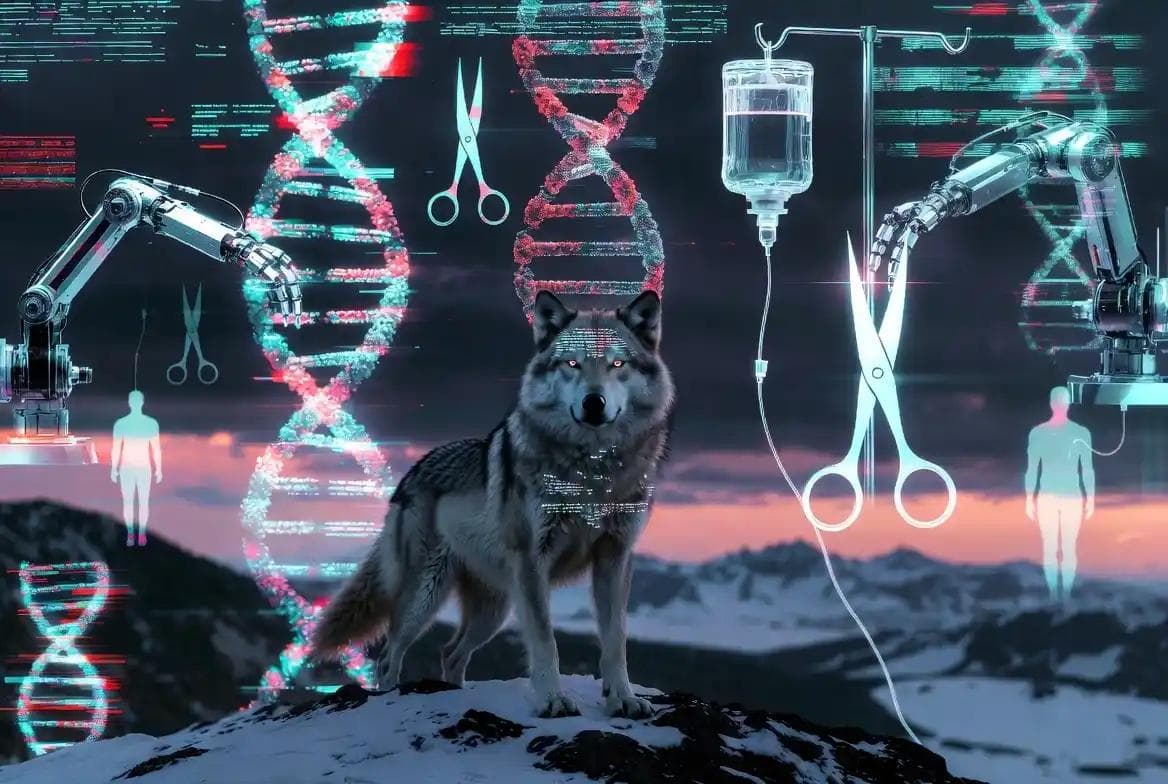
The Dire Wolf "Resurrection"
Colossal Biosciences' 2025 Gene-Edit Stunt Exposes the Real Playbook for Health Tech's Next Grift
Look at these claims. In April 2025 Colossal Biosciences paraded three gene-edited gray wolf pups (Romulus, Remus, and Khaleesi) as the first "de-extincted" dire wolf; a 10,000-year-old apex predator supposedly back from the dead. Scientific reality? A few dozen CRISPR tweaks on modern canid DNA; no true resurrection, just a publicity-engineered proxy that earned the company a $10 billion valuation and the 2025 "Screamers Award" for hype. This was never about restoring ecosystems. It was a proof-of-concept demo for the next revenue stream: turning ancient DNA tools into human longevity factories. And the mechanics scream inefficiency wrapped in venture-capital theater.
Strip away the press releases. The workflow relied on AI to reconstruct fragmented dire wolf genomes from fossils; robotics to automate precise edits, embryo implantation, and surrogate monitoring. Efficient on paper (surrogates were domestic dogs; no mass cloning failures reported). But the underlying system flaw is identical to every biotech "breakthrough" since the Human Genome Project: massive upfront capital (Colossal raised $615 million) funneled into patents and IP, while the actual ecological or medical payoff remains vaporware. Conservation? The pups live on a guarded preserve; rewilding plans are vague marketing. Health tech direction? This exact pipeline (ancient sequence + AI modeling + robotic delivery) is already being repurposed for human applications.
Speculate on the logical extension, because the incentives point there. Human lifespan alteration becomes the obvious next product. AI can now scan mammoth or dire wolf genomes for robust traits (cold tolerance, muscle efficiency, perhaps even slower cellular senescence) and port them into human iPS cells. Robotics handle the scale: automated organoid farms growing edited tissues for longevity trials; synthetic wombs bypassing ethical landmines around surrogacy. Popular pipe dreams like "biological immortality" or "upload-ready bodies" suddenly look plausible on a PowerPoint slide. Imagine a subscription model: annual CRISPR top-ups to knock out aging pathways, paired with robotic exoskeletons that keep your 140-year-old frame mobile. (The irony: the same VCs who funded this wolf stunt will sell you "eternal youth" while your pension fund collapses.)
Yet the pragmatic outcome is brutally predictable. Corporate greed ensures the technology lands as luxury gene therapy for the 0.1 percent; the rest of humanity gets the externalities (off-target mutations, regulatory capture, skyrocketing healthcare premiums to subsidize the rich). Robotics and AI accelerate the lab work, yes; they also concentrate power in whoever owns the proprietary pipelines. This is not systems optimization for longevity; it is rent-seeking dressed as salvation.
Expect the cycle: more dire-wolf sequels (moa, dodo, bluebuck already queued), more celebrity investor tweets, more headlines claiming "extinction is over." Meanwhile real biodiversity crashes and actual human health metrics (obesity, metabolic disease) worsen because the incentives reward spectacle over prevention. The system was never broken by accident; it was engineered this way. De-extinction success in 2025 proves the machinery works flawlessly; for profit, not people...